By Daphne Xia
Pastel pink designs, a unique slogan, and aesthetic pop-up stores – Glossier is one of the most popular beauty and skincare brands now. Its reviews are found everywhere on social media, and its pop-up stores are full of eager customers. As one of the first brands to promote skin positivity, Glossier’s slogan of “skin first makeup second” is quite original considering just about five years ago, the classic Instagram look entailed full-coverage foundation and heavy eye makeup.
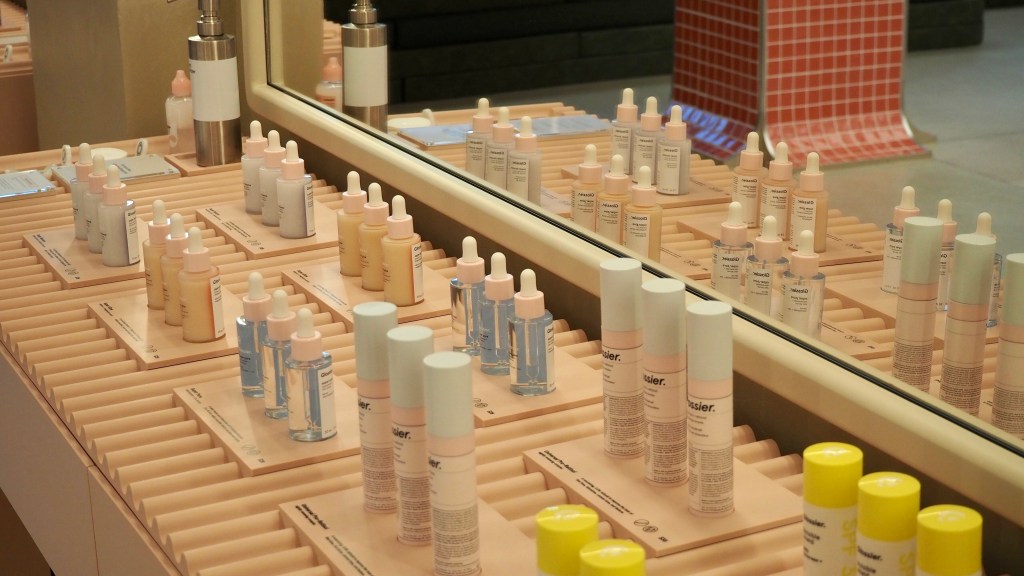
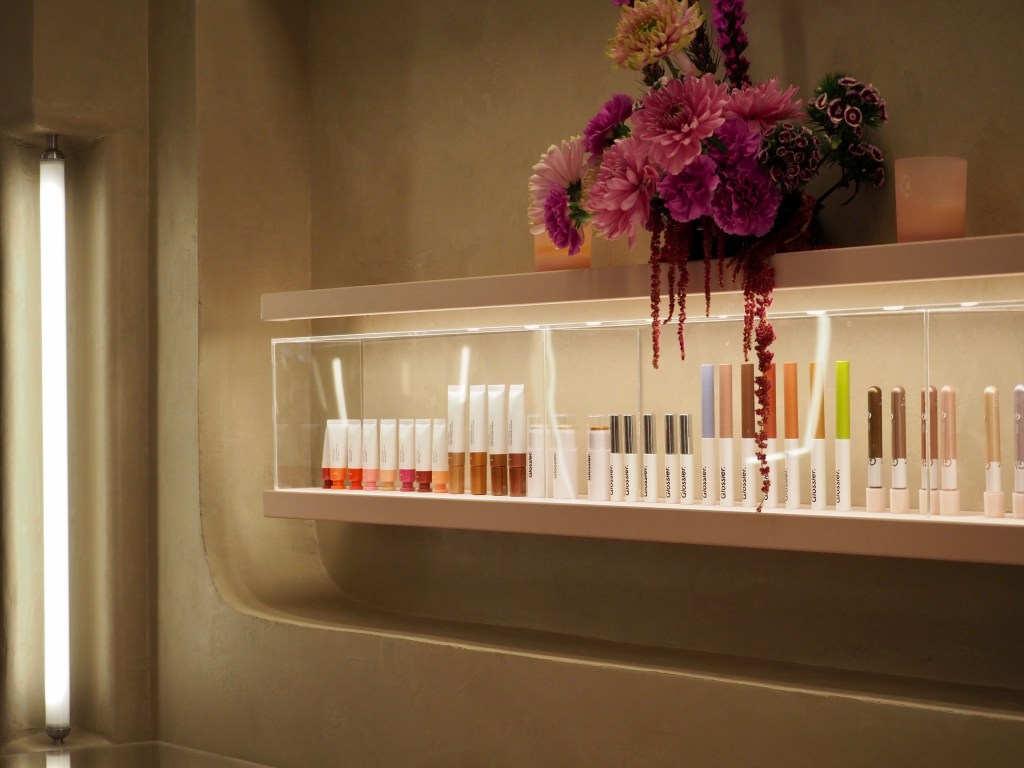
Glossier’s skincare and makeup products are being displayed in its location at Capitol Hill, Seattle, Wash., on Sunday, Nov. 21, 2021. Customers purchase and receive their products by waiting by a window and pick up their order when their names are called.(Photo: Daphne Xia)
Beauty trends are moving into the era of skin positivity to “stay ahead of the cultural curve,” which encourages embracing one’s imperfections. Marketing strategies are adapting to the new definition of beauty and leading positive conversations among brands.
Professor Rosanna Smith, whose area of expertise includes authenticity, beauty, and branding, at the University of Georgia thinks that what partially contributed to Glossier’s success is that it struck at the right time “when the no-makeup movement was really exponentially growing.” And it was one of the first brands “to be aligned with the contradictory notion of no-makeup makeup.”

Glossier uses artificial mountains and plants as main decor pieces while having white and pink as its theme colors in its new location at Capitol Hill, Seattle, Wash., on Sunday, Nov. 21, 2021. Glossier is known for its aesthetics and designs. (Photo: Daphne Xia)
Jessica Jou, a second-grade teacher at Renton School District, Seattle, said that she likes Glossier because she wants people to see her as who she truly looks like and to view her appearance based on reality.
“I don’t enjoy the idea of hiding and changing my features to something that isn’t natural…I never want to be caught when I take off my makeup and they think I’m a completely different person,” Jou said.
Other than its mission statement, Glossier also receives popularity in its creative department. Its white capitalized “g” in a pastel pink background makes up a memorable logo. Its package designs are aesthetically pleasing, making people love their design sometimes more than the products.
“Their packaging is carefully designed. Like, I’ll buy it mostly for the aesthetics, how well it works is the second concern, especially for Glossier,” said Hannah Bi, a senior at the University of Washington.
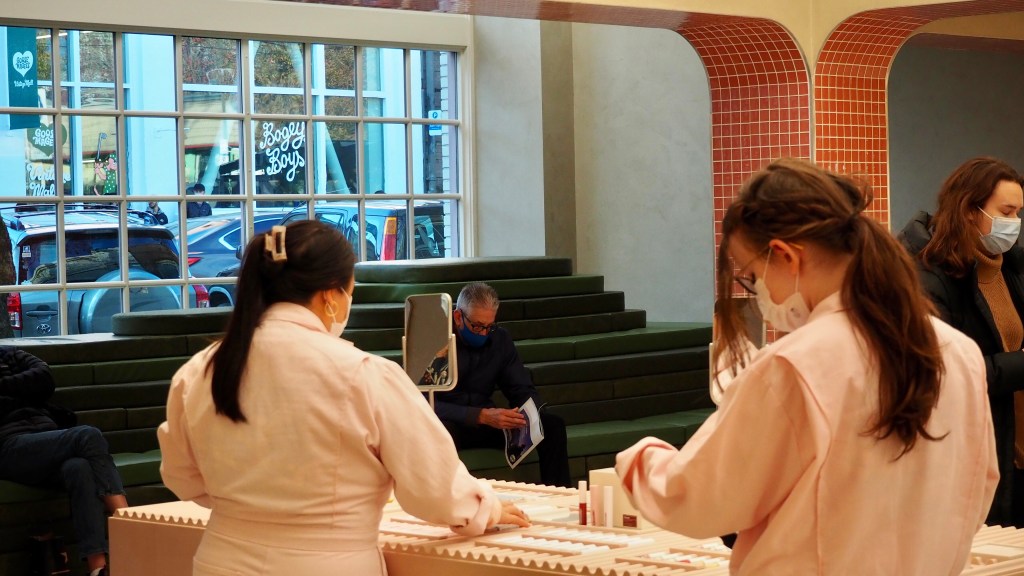
Glossier employees in pink jumpsuits are organizing and sanitizing the counters that display the products in Glossier’s location at Capitol Hill, Seattle, Wash., on Sunday, Nov. 21, 2021. The brand opened its first permanent location in addition to the New York City headquarters in Capitol Hill, Seattle in August. (Photo: Daphne Xia)
However, not all voices about Glossier are praise and compliments.
Marian Mohamed, a senior at the University of Washington, first knew about the brand when she was 16. As someone who just got into makeup at the time, she experienced confusion and uncertainty while looking at Glossier’s products because of their lack of inclusiveness.
She said, “I got so confused because the shades were so weird…they have like a total of 5 darker shades.” Moreover, she felt intimidated since she was a beginner in makeup. Mohamed brought up Fenty Beauty by Rihanna as an example of brands doing a good job in inclusiveness.
When being asked about the brand’s mission, Melanie, an employee at Glossier, replied with a well-rounded yet official answer regarding inclusiveness.
“We cater to all types of customers. Glossier is very open to everyone, all walks of life. And it doesn’t just cater to one audience or one specific beauty type or trend,” Melanie said. “We are more about playing, having fun, and experimenting, no matter who you are, what your makeup preferences or skincare are.”
A Glossier employee shares the brand’s vision and what they hope to provide as brands. One can see her interaction with customers, the store’s routine of sanitizing, and a customer trying out an eyeshadow product. (Video: Daphne Xia)
Despite the call for embracing imperfections, the pressing question is that, is this trend really freeing people from having to conceal and feel shameful about their skin condition?
A few years ago, the typical Instagram look consisted of defined brows, matte-finish foundation, heavy contour, highlight to the gods, and glamorous eye makeup. Nowadays, the “no-makeup” makeup look dominates social media with its light coverage foundation, freckles, and natural-looking brows.
According to Professor Smith, the “no-makeup” trend doesn’t boost people’s confidence about their appearance or necessarily relieve them from having to conceal their imperfections – it just steers to another direction.
“It’s like, oh, everyone’s not wearing makeup now. But that’s not really what’s happening,” Professor Smith said. “It’s that everybody wants to seem like they’re not wearing makeup now, which is very different.”
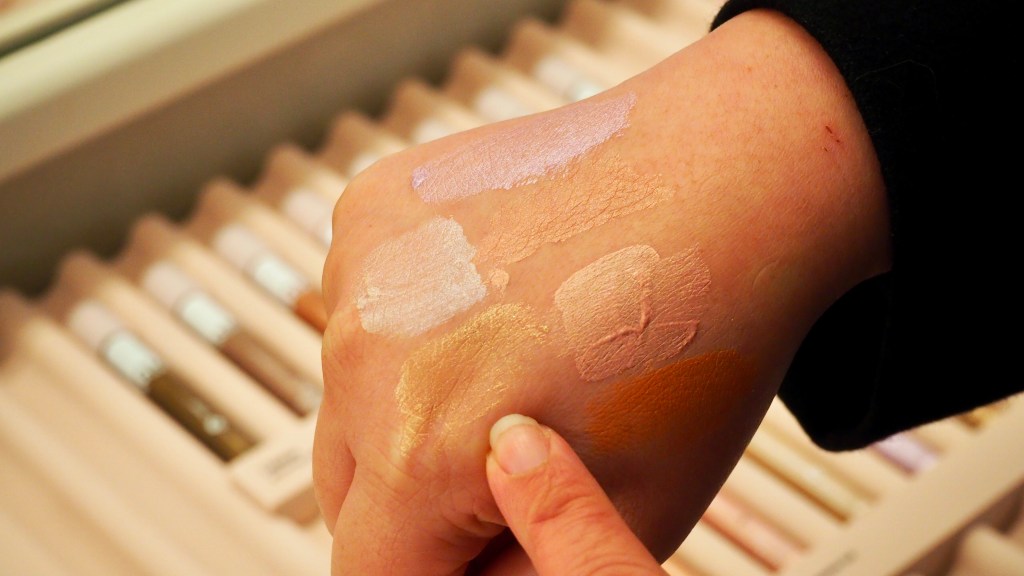
A customer shows the eyeshadow swatches she did on her hand in Glossier’s location at Capitol Hill, Seattle, Wash., on Sunday, Nov. 21, 2021. Glossier offers both products that have vibrant colors and products that don’t conceal or alter facial features. (Photo: Daphne Xia)
Essentially, the “no-makeup” movements “highlight another aspect of appearance enhancement that consumers need to manage,” which is “the amount of effort others believe went into their appearance.” The goal has changed from looking beautiful by using cosmetics to looking beautiful without other people being able to tell how hard we try to achieve that look.
“I think that my findings support that overall, it didn’t necessarily liberate people or liberate women in particular,” said Professor Smith. “It didn’t necessarily lead women to embrace their actual natural appearance at least. It looks like it overall encouraged women to just work harder in a different way to achieve beauty.”
The pressure of trying to look physically appealing is still there. As Professor Smith mentioned, many teenage girls on Instagram are still very depressed due to all the comparisons.
Whether it is visible makeup with heavy contours or natural-looking makeup that creates the illusion of “I wake up like this”, emphasis on physical appearance stays as a focus of our daily life. And brands, with the ultimate goal of selling products, may not be genuine in caring about how comfortable you are with your skin.
 Daphne Xia
Leave a comment